
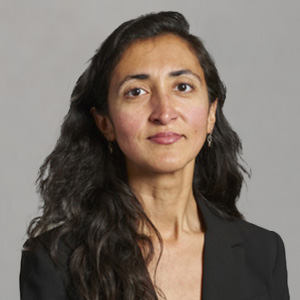
EP. 29
Farrhat Arshad KC
Barrister, Doughty Street Chambers
Farrhat Arshad KC on Vicarious Trauma at the Bar
Farrhat Arshad KC is a criminal barrister at Doughty Street Chambers who took silk in 2024. She discusses vicarious trauma in serious criminal practice — the structural conditions that produce it, what the bar's wellbeing conversation misses, and how she has managed it across a career built on the most serious cases.
Farrhat Arshad KC was called to the bar in 1998, built her practice on the Northern Circuit through serious crime — violence, firearms, kidnapping, and serious sexual offences — and took silk in 2024. She is a tenant at Doughty Street Chambers and has spent much of her career defending in the Crown Court, with a growing appellate practice as fresh counsel.
In this episode, recorded shortly after Farrhat spoke at the Get Briefed leadership conference, she addresses the cumulative mental cost of representing people whose cases involve the worst days of their lives. She traces how convention once protected junior barristers from the most serious content until they were ready — and what has been lost as that structure has eroded under the pressures of the criminal justice backlog. She also takes on the gap between the bar's wellbeing conversation and the conditions in which barristers actually work, and sets out four specific practices she has developed to manage the work across a long career.
For most people, when they go to the Crown Court — either as a defendant or a complainant — it's the worst day of their life. And for us, for the judges, the solicitors, the barristers, it's our everyday. Someone else's worst day is my everyday. That can't be good.
Farrhat Arshad KC, Barrister, Doughty Street Chambers
Farrhat also addresses the relationship between vicarious trauma and bullying at the bar — arguing that the profession has moved from denial to a binary victim-and-perpetrator framework, and that what is needed is something more human: an understanding of why people behave the way they do under sustained pressure, and what institutional change would actually look like.
Share this episode
In this episode
- Farrhat's route to the bar from a non-traditional background, her two-week stint at a city firm, and what drew her to criminal law from the moment she set foot in a Crown Court.
- Building a practice on the Northern Circuit — serious violence, firearms, kidnapping, and serious sexual offences — and the solicitor relationships that enabled it.
- The convention that barristers should not handle rape cases until seven years' call, where it came from, why it protected junior practitioners, and why it has disappeared.
- The emergency response driving junior barristers into serious cases before they are ready, the stress it places on individuals who are self-employed and feel personally responsible, and why senior clerks and solicitors need to step in.
- The gap between the bar's wellbeing conversation — Bar Council events, CBA working groups, chambers training — and the reality of a judge demanding written submissions by nine p.m. mid-trial.
- The relationship between vicarious trauma and bullying: why Farrhat argues the profession has moved from denial to a binary framework that lets the institution off the hook.
- What taking silk means in terms of responsibility — the lines in the initial letter, and Farrhat's decision to use her position to speak up for juniors.
- Four concrete practices for managing vicarious trauma: naming it, drawing firm lines around work, physical health, and colleagues you can talk to about the cases themselves.
From this episode
Farrhat's central point is that vicarious trauma at the criminal bar is not primarily a personal resilience problem — it is a structural one. The erosion of the conventions that once paced junior barristers' exposure to serious content, the listing pressures that leave no space between trials, the culture of bravado that treats asking for time to prepare as weakness: these are not individual failings. They are conditions the system has created and continues to sustain. Individual coping strategies matter, but they are not a substitute for institutional change.
On bullying, she argues that the profession has moved from denial to a binary victim-and-perpetrator framework — and that while naming and calling out bad behaviour is right, it stops short of asking why people are behaving badly. Without that question, the institution is let off. Someone shouting in the robing room may be carrying years of accumulated trauma. That does not excuse the behaviour, but it changes what a useful response looks like. The profession needs both accountability and the willingness to ask what it is doing to the people inside it.
Vicarious trauma is a recognised occupational risk for barristers and chambers staff who work with distressing content.
Our Vicarious Trauma Training for the Bar covers what vicarious trauma is, how it manifests in legal practice, and the steps individuals and chambers can take to recognise and address it. The course carries 1 CPD hour and is built specifically for the Bar, with scenarios drawn from criminal, family, and immigration practice.
About the guest
Farrhat Arshad KC
Barrister, Doughty Street Chambers
Farrhat Arshad KC was called to the bar in 1998 and built her practice on the Northern Circuit over eleven years before joining Doughty Street Chambers. She practises in serious criminal defence, with particular experience in serious sexual offences, serious violence, firearms, and appellate work as fresh counsel. She took silk in 2024. She came from a non-traditional background — first in her family to attend university — and read law at Oxford before completing a masters in public law.
Transcript
Orlagh Kelly: Delighted to have you on our podcast, Farrhat. Obviously a silk at Doughty Street Chambers, a very prominent crime specialist, and I'm really looking forward to our conversation today. We had the benefit of you speaking wonderfully at our leadership conference this year, bringing a lot of insight into the life of not just a female barrister at the top of her game, as I would say, but one who has to deal with complex and confronting legal topics and evidence. We had a great insight from you at that stage around how that can affect lawyers, and we talked about vicarious trauma. But before we get into that, I wonder — can you tell us a bit about your background and how you came to decide that you wanted to come to the bar?
Farrhat Arshad: Yeah, sure. There's a couple of answers to this question, because barristers are often asked this, either formally or informally. And when you look back, you try and identify that point where you thought, yes, this is both a specific profession and the area. For me, it was twofold, I think. I come from a non-traditional background — Pakistani first generation immigrants, both my parents. Me and my siblings were the first to go to university. And if you're from a background like that, it's very much: you've got to do a proper degree and a proper job. Those who are from that background will know what I mean by "proper". So because I wasn't into maths and science like most of my siblings, for me, I had to think of a degree I could do that would allow me to do humanities A-levels, because that's what I was interested in. I thought, law — they'll let you into law if you do fun subjects.
So that's how I got into law.
Orlagh Kelly: Is that what you thought, humanities was a fun subject.
Farrhat Arshad: Well, no — the humanities A-levels. Well, I think I did English, history and Latin, but I had to justify those choices to my dad: "What are you going to do with those A-levels? They're not going to lead to anything useful." I was like, yes they are — they're going to lead to a law degree, which, obviously, humanities A-levels could get you into a law degree. And I think that was my thinking: I can do the fun subjects — to me they were fun subjects — and I could then go on to do a law degree. But if I think back earlier, actually, again because of my background, we didn't come into contact with professionals very much. It was a very working class background. But I remember when I was about eight being told that a female, quite distant relative was coming to our house. She must have been in her 20s. And I just remember my parents saying, "She's a barrister." And there was this awe in their voices: "She's a barrister." And I was like, I want to be one of those. No idea what it is. But if it induces awe in my parents, it must be something good.
And I think that was somewhere wobbling around in my head, and then I ended up doing law, briefly flirted with a city solicitor firm when I was at university because everybody was applying for them. I did a two-week stint at a city firm and that put paid to that — it was like, yeah, no, this isn't for me. And so I went back to being on the barrister track.
Orlagh Kelly: Okay, and did you find that sort of academic route and the route to pupillage, et cetera, fairly straightforward, or did you have to do anything different to make sure you got where you wanted to go?
Farrhat Arshad: It was pretty straightforward for me, I think probably because I did my undergrad at Oxford, so I was lucky in that sense that if you're from a non-traditional background but you get into somewhere like Oxford, it does ease your path then to go into something like the bar. I have to be honest. So I think for me that was useful.
Orlagh Kelly: Okay, very good. And when did you get called to the bar?
Farrhat Arshad: '98. And I went to Cloisters, which was then a mixed set — civil and criminal. I was supposed to be a public lawyer. By then I'd done, I think, a masters in public law and I was all set to be a public lawyer. But at Cloisters they made you do crime in your second six, and the minute I set foot in a criminal court I thought, oh, this is what I'm supposed to be doing. And I think it was the advocacy, it was the immediacy, and it was the sort of messy humanity — and straight away you were thrown in: deal with this. And I think that's really what attracted me to criminal law.
Orlagh Kelly: Okay, and so it's really straight from pupillage that you have been in crime — that has been the area that not only have you specialised in but you have felt somewhat a calling towards. Would that be fair to say? Or too strong?
Farrhat Arshad: No, I very much feel that my job is a vocation, actually. It might not be something that everybody would say, but for me it has been very much — because whether it's wrongheaded or not — I certainly started out with the idea that I could help people who are in a difficult situation. I think that's probably developed over the years and it's probably a bit more sophisticated now. But yes. Calling might be putting it a bit strongly, but not far off.
Orlagh Kelly: You know, called in 1998, you took silk earlier this year, 2024, I believe — is that correct? So this has been your profession from, I'm guessing, your early 20s. You're really steeped in it. And you're at the wonderful Doughty Street Chambers, which is obviously eminent in this area as well as many other areas. Can you think about your early career as a pupil — as a female, I guess — in those late 90s, early noughties? What was the world of crime and criminal law like for a female pupil and young barrister at that stage?
Farrhat Arshad: So mine is slightly complicated. My story is slightly complicated by the fact that I did about three or four years in London. And very much — I wasn't at Doughty Street then. I was at Helen Grindrod QC's then set, Devereux Court. And I was very much knocking around the magistrates' court, and I wanted to get on faster. And I knew that if I applied outside of London for tenancy, I'd do better. So I went to Manchester. And so for about — until I stopped in 2013 to have my daughter — for about 11 years, that was where I cut my teeth. So I'd had this experience in London for a few years in the magistrates' court, and then essentially the majority of my Crown Court work was in the Northern Circuit. And for me, it was fine. I was very lucky — very quickly to get instructed by Robert Lizar Solicitors, a big firm in Manchester, and Nicola Hall in particular is a real champion of women. And so I flew — I got brilliant cases, I got serious cases, I got cases that men would normally get. Nikki and I very quickly built up a relationship. And other solicitors as well — Phil Barlow was a really good solicitor of mine, who would just trust me with their cases and didn't care that I was a woman. So I was very lucky. I'm not sure that's the universal experience.
But for me, that was very much my experience. And I wasn't just the usual pigeonhole of doing sex cases. I was doing sex cases, but I was also doing quite serious violence — firearms cases, kidnappings, all sorts, really.
Orlagh Kelly: And can you think about any of the more interesting or unique cases that you've had during your career that maybe ended up in the press or that anyone would have heard of?
Farrhat Arshad: There was a case — I don't know if anyone would remember it now, I've had a few — but from back in the day, there was a school teacher who fired an air pistol at some youths. She was called Linda Walker. It became quite a core celeb in Manchester because she was a teacher and they put her in prison — there had been yobbish behaviour or something. So that was my first taste of doing a case that threw you into the limelight. I was fairly young; I can't now remember how young, but that was very interesting. But I just did what I always do — you do the job, I concentrated on the case, I concentrated on the evidence. I do remember having to go to the Court of Appeal to argue against conviction and sentence. And the public gallery, which is usually empty in the Court of Appeal, was completely packed, including people I recognised from Channel 4 News. And I remember thinking, my God, I know who that woman is. But again, you know, it's our training — you just get your head down, you look at your brief, you get back into what you're there to do, and you ignore all the noise really, you ignore all the other stuff, which I was able to do.
Orlagh Kelly: Well, that's interesting, of course, because although the general public typically hear about a lot of criminal matters by virtue of the news, they're not anywhere near as involved in the nitty-gritty, the detail, or — thankfully — exposed to some of the difficult content that barristers and solicitors, judges, and other people involved in that court process are exposed to. So if I recall correctly, although it really seems that you've had a grounding in many different areas of crime, you have over time become somewhat specialist in serious sexual offences.
Farrhat Arshad: Yes, that's very much part of my practice. Because one of the things I've always tried to do is make sure I'm not pigeonholed into — because I'm a woman — just doing sex cases. And as I say, because of my own experience, I've been lucky to get instructions in serious violence, in drugs, in kidnapping. You as the individual barrister have to keep that balance — so I do sex cases and I'm very experienced in them, but I also do serious violence. I am very much in the blood and guts rather than in the white-collar fraud end of things. But within that, there is a spectrum. But yes, I've done very many sex cases.
Orlagh Kelly: And is it correct that you have essentially not only not wanted to be pigeonholed as a professional — and that you want your own variety and, I'm sure, your own ability to develop your skills — but that from a mental health perspective, planning and cognisance has to happen to make sure that when you are constantly exposed to certain types of content, you take steps to try to protect yourself? Would that be fair to say?
Farrhat Arshad: I think it's quite difficult to answer that question because doing a variety of work does help. But once you get to a certain level in crime, there's a certain level of seriousness. And if you're doing the sex and the violence, it's pretty much all going to be fairly grim facts — something terrible is going to have happened in some way to someone. So saying, I'll take a time when I won't do sex cases — well, actually, yes, but it will be replaced with a conspiracy to murder. And now, since I've taken silk, it's either murders or it's private cases which are of a certain level of seriousness. And because of that, it's not really a respite. There are other ways I take a respite from the work and the grimness of it, which I can come to in a moment. But actually the variety of cases doesn't necessarily help with that — and the other thing worth pointing out, particularly, I think it applies for those who prosecute as well as those who only defend: when you defend, it's not only that you're being exposed to difficult content, but you have a grave level of responsibility. And it's that combination — in any job, if you're very responsible it's going to cause you stress. In ours it's even more so, because you've got that level of stress and responsibility and then you've got the grim content as well. And that's a lot for one person to manage.
Orlagh Kelly: And I'm going to expect then that you're dealing with clients who are in a very stressful period of their life — who are potentially suffering from mental health problems and traumatic experiences in and of themselves. Would you say that your academic pathway or your early training prepared you appropriately to deal with clients who have complex needs around that?
Farrhat Arshad: Probably not. And I think it's very much something that you learn as you go along. Again, I was lucky, but I think both because of the time and because of where I was — when I started in the late 90s there was much more of a structure to it, even at the bar, where there was a certain understanding that, for example, you wouldn't do certain cases until you were at a certain level of call.
So for example, it used to be across the board that a barrister would not touch a rape case until they were seven years' call. And I remember being told that — these days it's gone completely out of the window. But that protected us. I remember being three years' call, I think, and thinking, should I do a section 18? I think second-six pupils are doing section 18s now. GBH.
Orlagh Kelly: What's a section 18?
Farrhat Arshad: Sorry, causing wounding or grievous bodily harm with intent. So, a serious offence which, if you look at the sentencing guidelines, carries a serious penalty. But such is the state of the profession in terms of people available that people are doing very serious cases much younger. And that's why I say I was lucky because we sort of grew into it. Now, in one sense it's a bit like frogs in hot water, the water is getting hotter and you're not realising it's getting hotter. But on the other hand, there was never a moment where, bang, you think to yourself, my goodness, what's this? It's steady — it steadily gets worse. And I think part of the problem though with that is you don't always realise that you're steeped in traumatic content and you're obviously reacting to it, but you don't always realise you are.
Orlagh Kelly: I'm fascinated about the potential, not rule possibly but the expectation that there were certain levels of call you needed to reach before you took on certain cases. It was probably due to the fact, possibly the complexity and experience required, but also the resilience that you might have needed to build up before then. I have never heard about that — that certainly did not exist, to the best of my knowledge, in Northern Ireland when I was at the bar. And I wonder where that came from. Is it the clerking teams maybe that you were working with?
Farrhat Arshad: I think it was the convention, you know — like a lot of things in our profession, there's nothing...
Orlagh Kelly: It's just the way it's done.
Farrhat Arshad: And maybe it was a Northern Circuit thing, but I don't think so. I can't now remember whether that happened to me in London as well, but certainly once I was in Manchester from 2002 onwards, that was just what happened — you would do certain cases. And very quickly I was given much more serious cases when I showed I was able to do them, but there would be more reluctance, I think, from clerks and from senior members of chambers — more of an oversight of who's doing what and are they up to it, basically. Watching and looking out for the younger members actually. And maybe that was informed by: is there the resilience? But also is there the experience? Can they manage it? So it felt more protected in a way.
Orlagh Kelly: It's interesting — we might have to crowdsource some information when we publish the podcast, to ask people if they know where this convention came from and identify the root of it. And is the Northern Circuit different? Do they behave, act and expect different things from their members compared to the London bar? Just an interesting observation. I've chatted about it before, but I did, three months into being on my feet, I know that I was asked to mention a case for a more senior barrister who was away at the time. It was a children's law case, but it contained information around sexual abuse, which I had no idea about when I really opened it to read it. Now, if I recall correctly, she might have said, you just need to adjourn this — you don't need to read all of it. But I hadn't read between the lines of what she meant, and being the fastidious student that I essentially was at the time — like all baby barristers — I wanted to know all the details in case the judge asked me something. And it was very confronting. And to be honest, I probably wasn't well prepared for it. And it was just written detail, it wasn't photographs or anything. And so I've been cognisant of that ever since — that there is not a formal protection, as far as I'm aware, for younger barristers as they progress in their career, although there certainly seems to be a lot more awareness now.
I guess the world has moved on — even over and above the bar, to indicate there are trigger warnings about sensitive content that people can choose whether they want to deal with that or not. Do you think, given the way that there were inherent protections, wherever those conventions came from, largely protected you at that late 90s and early noughties stage, and yet we've moved to a world where such are the waiting lists for prosecutions, support lists that, not to be patronising, baby barristers are essentially being moved into doing work that, in your day and in my day, that would not have happened, is that something that has been well thought through and planned, or is that an emergency reaction? Is the fact that these very young people are now being expected to be exposed to this content a negative rather than a positive?
Farrhat Arshad: I think it's very much an emergency response and I don't think it's been thought through. And I think it needs to be, because it's very short-sighted. If they're not ready, and if something goes wrong, they will very much take it on board as a problem with themselves. And that's one of the problems with our profession — because you're self-employed, there's an idea that you just take on much more responsibility than you should. Even though, you know, it wouldn't be the individual barrister's fault what case they were given — somebody made the assessment that they were able to do it. A lot is put on the individual barrister, and that's not fair or right, because they will then take on the responsibility and the guilt if something goes wrong when they shouldn't. Or the stress will be so much that they can't do it. And they will probably do that case, but they may not want to stay in crime — and it's cumulative.
There's a reason that in most professions there's a steady increase in responsibility, because we're human beings — it's what we can cope with. We're ready now, we've got that level of experience, right, I'm ready again to move to the next level. If you just throw people in, they're not going to be ready. The other thing is, it's very hard for an individual barrister who is ambitious and wants to make it to say, actually, I'm not ready for this. I remember I did it, way back, there was a case — I think I was again two or three years' call — and I just looked at it and thought, I can't do this. Now, I still think that was quite brave of me, because you're saying to your senior clerk and to your solicitor: I'm not up to this. And I was two, three years' call, I was ambitious, I wanted to be up to it. And I worry that nowadays the young barristers, wanting to make it in a hugely competitive environment — more competitive than it was for us, and it was pretty competitive then; it just gets worse — they're not going to be the ones who say, no, I don't want to do this. And so I think other senior members of chambers, senior clerks, solicitors — they actually need to look at it and think: can you do this?
Orlagh Kelly: And is it fair to expect you to do that? It's unreasonable. I mean, a lot of people can get to a stage — particularly if they're senior solicitors and senior clerks — where they have grown children who are potentially the same age, and they could think to themselves: I wouldn't want my child having to do this — they're not ready for it. And as we discuss this, it does occur to me — there is the much-talked-about funding issue for the criminal bar and for the criminal justice system all throughout the UK. That's one issue. The fact that talented barristers can't make a living in some cases and have to leave and find a career in another part of the bar, or completely elsewhere, regardless of the fact that they could have done a great job and really brought a lot of value for access to justice. But it just strikes me that taking very young people and putting them in the line of fire with all of this traumatic content and complex legal issues that they're probably not really ready for, cannot lead to good things. It's bound to lead to mental health issues, triggered responses, post-traumatic stress — and therefore yet another thing for the criminal bar to contend with that will essentially rock the foundations of the ability to create a system of lawyers who know what they're doing, to help provide access to justice.
Farrhat Arshad: That's why I say it's short-sighted. It's an emergency response — it fills the particular gap that we have at the moment, but there's no longevity in it.
Orlagh Kelly: There's a cost to it, isn't there?
Farrhat Arshad: But that's part of the problem — the way we're structured, there isn't a real oversight, it doesn't feel like there is oversight of the whole picture. How should this be working? A lot of discretion is given to the individual, to individual chambers, which has its benefits, but it also means that decisions are being made which aren't always looking forward to: where do we want to be in 10, 20 years? What does the profession look like in 10, 20 years' time? We're not having that conversation. We are currently, but...
Orlagh Kelly: Where does that conversation sit? Is that a Criminal Bar Association matter? Is that Bar Council, Bar Standards Board? Where does it sit?
Farrhat Arshad: All of it. And I think the criminal bar does grapple with it. And certainly the last few years, obviously, it's been in the headlines — it has been grappled with. But all interested parties need to talk to each other more. Because it's all very well the CBA saying this is what we need, this is what we want — and they do have these conversations — but there needs to be more, because you have these conversations about wellbeing. The Bar Council talks about wellbeing. The CBA talks about wellbeing.
We'll have events in chambers that talk about wellbeing, and you'll walk into court, Orlagh, and you will get a judge who says, right, I need your legal argument in writing by this evening. And you've just done a day in court and you're mid-trial, and they don't care whether you've got kids or responsibilities or whatever — you're going to go and you're going to prepare that piece of work. Or: I want agreed facts by X time. And there is still that assumption that if the work needs to be done, you've got to do it there and then.
You're not going to do it during the court day because we're going to deal with — we don't want to waste the jury's time. You're going to get that time and time again. We've got the jury here, we've got to do something in front of the jury. What can you call evidence? Can you read statements? Well, yes, Your Honour, but there's written work we could be doing. Well, you can do that later. And so there's very much this idea still that, for all this talk about wellbeing, if the way a court day runs and the way a trial runs doesn't take into account the needs of all those working within it — then what's the point of talking about wellbeing? If there's no give in the system to actually look after people's wellbeing by not overworking them, then what's the point of all the conversation?
Orlagh Kelly: Yeah, I'd agree. And I can think of numerous times when I would have been in court where deadlines were set — things had to be submitted by nine p.m. that night. I didn't have kids at the time, so it wouldn't affect me as much. But it would be something I would find difficult to do now. And it's not sustainable. I think a judge with the best of intentions assumes it's just for this trial, but it's not. It's for every trial and for every client. It's every week.
Farrhat Arshad: What's really instructive, though, is you get some judges who do get it. I had one recently where she was really good. I remember saying to her, I've been served with a lot of information — I could work all night, or you could give me Tuesday to look at it. She said, I'll give you Tuesday. But what was interesting is there was pushback from other judges in her court building, almost as if she was letting us get away with something. And she wasn't — she was doing the right thing for all of us. And it in fact saved time later, because if you're given time you will do it more quickly and you will do it properly. But that's a form of pressure as well — the idea from others, and it's not said, so you can't challenge it, but this feeling that you're not working to full capacity or you're not meeting the challenges. It's quite — maybe I'm taking it too far — but it's quite male language: you're not up to it, you know? Why can't you just do it when it needs to be done? Why do you need a day to prepare your cross-examination? And the answer is: because they just disclosed 5,000 pages of material, that's why. And I think it's incumbent on us — and I certainly have felt more able to do it since I got silk — we all as individuals have to say, no, this isn't realistic. And no, I do need a day actually to absorb this, because I want to do it properly. And it's hard for the juniors, so we have to do it. There's still this quite — and I do think it's a male thing — a bravado of: I'm fine, I'm up to it, yeah, I can do it. And of course we all work hard, but it should still be within proper parameters for the sake of all of us.
Orlagh Kelly: I often think about this type of thing, particularly when it comes to the content and the conversations happening around cases. If you worked in engineering or construction and you went onto a building site, you would have mandatory health and safety. You would have certain boots and hats and high-vis and goggles and all of those things to keep you safe. And yet from a mental health and wellbeing perspective as a lawyer, there isn't a lot of that protective gear available, and the ecosystem within which you work hasn't adapted to expect that you should have it and demand it. So, for example, again in construction, if someone in authority saw someone walking around a site without their gear, they would say: you can't do that — there's liability and risk. But in the ecosystem within which you work currently, that oversight doesn't exist. Would that be fair to say? There's something in trying — instead of just talking about wellbeing and trying to have the conversations and spread awareness — to actually change the ecosystem to understand it: that you operating there, and the younger barristers and solicitors, need the gear. They need the protective gear. And sometimes that protective gear can be formed of a more senior person saying, we're the health and safety people, and you're not allowed to work past five, and the court can't ask you to do that, and there are protections put in place to allow people to thrive and do a good job. And I don't ever see a system where very young barristers say no to a judge.
Farrhat Arshad: No, they're not going to be able to. And that's why I think, I think it's incumbent on all of us, if we can, to try and make changes. Because one of the difficulties is that wellbeing is in the ambient culture — we all know the buzzwords.
But it's reminding those in power — and it's not just judges, it's all of us. Whenever we have power over others, it's remembering to use it well. It's all very well saying wellbeing is really important, but whenever you're in a position of authority over others, it's thinking: what does that mean now? What does it actually mean to look after someone's wellbeing? So if I'm editing something, or if I'm writing something and I need something from other people, or if I need something from a junior when we're on a case — it's remembering: no, that's enough work, they've done enough work, it will wait. So it's very easy for us all to say, even as silks: oh, well, it's on the judges, it's on listing. It is. But it's also on you as well to make sure that you're mindful of it for others.
Orlagh Kelly: Yeah, I had a conversation recently with a neighbour of mine about wellbeing at the bar. He's a barrister, and he said, you know, people are talking about this, but I definitely feel it's gotten easier — especially since I've taken silk, everybody seems to really have gotten on board with wellbeing and understanding parameters. And then he said, someone else said: that's just because you've taken silk and you're getting to experience a different world. The juniors are all still — particularly the young juniors — in that world that you used to be in. Life gets more privileged the higher up you get — easy to forget.
Farrhat Arshad: It's really funny you say that, because I remember a friend of mine saying about silk: she said, you just need to get silk so you can get out of senior junior hell. And the way she put it was just so brilliant, because it is — and anyone at that level will know it is senior junior hell. And what I wanted to do, because I'm a new silk, was not forget what that is like, and what it's like below that as well.
Orlagh Kelly: Did you — it sounds like you were cognisant of the requirements and you were able to plan ahead over a number of years to make sure you had that. Was that something you were just aware of yourself, or was it something that your senior clerk helped you with? How did you typically get that level of preparation so far out?
Farrhat Arshad: I want to correct that slightly, because I was aware of the process and my chambers is very good — they get people in once a year, I think, to talk to those who are thinking of applying, usually the following year. And so I'd gone to one of those a couple of years before I was about to apply, just to know what I needed to be looking ahead at.
But that was literally all I knew. I knew I needed 12 cases of a certain level of complexity and sensitivity, and I knew that it had to be within the last three years. And that was literally my touchstone, my lodestar. Right — those are the cases I need.
Orlagh Kelly: And so thinking about you being nearly through your first year as silk, it certainly appears that you're already doing that piece where you are taking some responsibility for the profession overall, even just by being honest and encouraging other people to be honest so that they can follow in your footsteps. What's coming next? I'm expecting obviously you have a long silk career ahead. Now that you don't have to try to meet requirements and competencies, do you have certain cases you'd like to get involved in, or anything in particular you'd like to do?
Farrhat Arshad: So part of my practice has always been — I do the first-instance criminal defence and I want to carry on with that and develop it into a real continuing expertise, I suppose. But I also do appellate work — I do a lot of appellate work as fresh counsel, and that's from a defence point of view. That's exciting because now I'm silk, I'm hoping to expand on that, to build on that, to be able to bring cases on points of law.
I do that to an extent already, but once you're silk there's another level to it, and I want to expand on that and build on my expertise in it — just to be very good at it. You know, criminal law has always been seen as the poor relation — it's not a proper intellectual area, people who like chatting but aren't very intellectual do it — and I hate that, and I don't think it's true. It's really complex actually; criminal law is really hard.
And I want to be able to show that those of us who practise in it, we know what we're doing. It is complicated. And I suppose, just improve on that. But also separately to that, and it goes with what we were saying before — once you get silk, it is also about trying to change the environment, and change the way we look at the criminal justice system and each other and the profession, because I think there needs to be more humanity in it generally. There isn't enough acknowledgement — we don't remind ourselves often enough that we're all just human within the system. Both defendants and complainants, but also those of us in the profession working within the criminal justice system: we are human, we're fallible, we need to help each other.
Just to give you an example, talking about vicarious trauma — one of the ways I think it manifests itself is often low mood, but it's also irritability, snapping at others, being rude to people. And obviously you shouldn't be — not me, obviously — but you do see it around you all the time. And whilst on the one hand there's a real movement now, Talk to Spot, don't bully people, that's absolutely right and I would call for it — at the same time we've moved from not acknowledging all that to acknowledging it and having a very black-and-white view of it: there are victims and there are perpetrators. Well, actually, what we need is a more human approach of: let's look at — if somebody is shouting at a junior, or if somebody is shouting in the robing room at a colleague, why are they? What's going on? Is it because they're massively stressed? Is it because the weight of responsibility has got to them? Is it because years of vicarious trauma have got to them? And so I suppose it's just asking for nuance. It's asking for looking at people's humanity and just trying to work out why we're doing this — if we're doing it — and how to fix it, rather than just saying, they're a bully, full stop.
As I said, don't get me wrong — it should be called out. But it should be called out in a way that's going to help fix it, not just apportion blame without trying to understand why it's happening.
Orlagh Kelly: It's interesting, and it's circling back a little bit — both to wellbeing and to thinking about that junior cohort of barristers really having to take on work that none of their seniors ever had to in the past. And it's thinking about: well, what mental health problems will that cause? It's almost like there's a disconnect. There's a high percentage of alcohol and drug abuse at the bar. There's a high amount of depression. But it's not because of the people — it's because of the environment. You can't disconnect the work from the consequences of that work. And then there's a high amount of bullying at the bar. You realise, well, as you point out, it might be that people are not at their best selves due to the demands of the work. And holistically, if we could start to break it down and put some protections in place, there would be a general improvement for everyone — in their own personal health and then in the health of the profession. Yes, there's a lot to be done.
And that approach of "you're a bad person if you've shouted at someone and therefore should be cancelled" — that's not really helpful to identify and solve a problem.
Farrhat Arshad: I think it lets the institution off. Because again, with these buzzwords of wellbeing, a lot is put on the individual: you need to go and get counselling. Or even — I suppose — if we say, well, chambers should have training, and they should: I think they should have vicarious trauma training. They should get people in so that people coming into the profession are told, this is what it is — recognise it, deal with it — and have actual solutions, not just telling us what it is but what to do about it.
But that's all well and good, but it's very individualistic. There needs to be an institutional response. And it's what I was saying earlier — the system needs to take it on. Court listing, judges, the presiders, everybody needs to acknowledge that they're contributing to the environment, and therefore the system itself has got to allow for it, for any change to be meaningful.
You have to make changes to the court day, you have to make changes to unrealistic listings. All of that has to change if we want a healthier profession. You can't just put it on the individual: you're a bit broken, vicarious trauma broke you, now you're going to have to go and get yourself fixed. It won't do. It's got to be built into the institutions — setting themselves up in a way that means it doesn't happen in the first place.
Orlagh Kelly: Yeah, absolutely. So wrapping up — we've covered a lot of ground today. But thinking about vicarious trauma, are there things that you do personally? I recall you talking about a great piece of advice you got from your husband. I don't want to give him too much of a shout-out — for any husband, really — but it was something to do with, and correct me if I can't quite recall the phrase, running a marathon as opposed to a sprint. And it was something about taking holidays and resting.
Farrhat Arshad: Recovering on the run. That's right. Yeah, he had said that to me, and it was really nice to hear. Because the talk I did for you was in April, and that was literally off the back of getting silk, having the ceremony, preparing for my party — a lot was going on both personally and professionally. And I think my mind was still spinning, and I remember talking to him about it.
Orlagh Kelly: Yeah, that's it.
Farrhat Arshad: And he's much more sporty than I am. And he just said: if you can't always stop running, then you recover on the run. It's about carrying on working, but also taking the measures you can within that to look after yourself. I do have specific things I do and I think it's taken me a long time to realise that I need to do them, and I'm happy to share them.
Orlagh Kelly: Please do, yeah, absolutely.
Farrhat Arshad: I'd say there are four key things that have to happen for anybody to deal with work stress or vicarious trauma. The first one is: you have to face what you're involved in. You have to call it. We don't always realise that our day-to-day work is traumatic. And it took me ages to realise. I remember once suddenly thinking: for most people, when they go to the Crown Court — either as a defendant or a complainant — it's the worst day of their life. The worst thing that's happened to them has led them to the Crown Court.
And for us — for the judges, the solicitors, the barristers — it's our everyday. Someone else's worst day is my everyday. That can't be good. And that was the first moment it really crystallised. My goodness — if you're faced with someone's worst day every single day, what is that doing to you mentally? So I think we need to recognise that and call it. Because just naming things is incredibly powerful. Saying: I'm in a profession where it's hard and I deal with hard stuff — and give yourself some credit for that. I'm in a tough profession. And I think that's one thing I've learned to do over the last few years.
Secondly, draw firm lines around work. Now in something like the criminal bar, when you're a trial lawyer, that doesn't mean working nine to five — you can't do that. When I'm in a trial, I'll be honest with you, I work all the time. My timetable would be: I work from 5.30 in the morning until I have to leave to go to court. I then do the court day until 4.30, and then I work on the train, or I work in the hotel if I'm staying away, and then I work two or three hours in the evening. I work all the time. But that's just the way I work — I'm not advocating it for anybody else. If I'm in a trial, that's how I have to work. But what I do do, given that I work like that in a trial, is when I'm not in a trial I try and stop. I don't always manage it. You have to give yourself time off, you have to look after your health.
And so I see it a bit like being an athlete. You're in a trial — you're in the Olympics. You're not going to rest; you're just going to do the Olympics. Then when you're not in the Olympics, take some time off. Or if you don't work like me, if you're more measured, build in time off. It's very interesting that when I had my daughter, I was suddenly able to say, once I came back to work, I'm not going to work on weekends. And I was able to justify it, because — let's be honest — we have to justify not working to ourselves if we're ambitious, hardworking people. Well, she needs me, and it would be wrong not to be around at the weekends because I'm not around during the week. I could never do that for myself. Before I had her, I was never able to say, actually, I shouldn't be working on the weekend — because what about me? But I could do it for somebody else. I could say I'd do it for my daughter, but I couldn't do it for me. Everyone should be doing it, even those who haven't got children — you'll have some other life. You should be doing it for yourself. So I'd say that unless I absolutely have to, I don't work at weekends.
Thirdly, I look after myself physically — I eat well, I try and exercise, and I try to sleep at least seven hours a day. And I think all of that is really important. Because the better you are physically, the better you are mentally.
And I've left it till last, but it's probably one of the most important: you've got to have good friends and colleagues around you who you can talk to. It's essential. Because there are some cases — for example, if I'm dealing with a really serious child sex case — I'm not going to talk to even my husband about it, because I can't. The subject matter is too awful; you almost don't want to bring someone else into it. But I can talk to colleagues, because they will have done that work. They will be privy to it and understand it. And I'm lucky to be in a really good chambers where I've got great colleagues, great friends, who are all really supportive of each other. And when you need to, if you really need to, you can just ring someone up: I just need to talk to you. And it's really helpful to be able to just talk to people — literally just about a case — and you feel instantly better. So I would say to people: find people who understand the work you do, and talk to them.
Whether women are better at this than men, I don't know. I hope men do it too, because they really should. It's not an admission of weakness — it's just an admission of humanity, I suppose. We all need to do it.
Orlagh Kelly: I think that's great advice and a great four points to land on to close such a great podcast. It makes me think about the benefits of coming into chambers frequently and meeting colleagues who are working on the same kind of cases. And I know that post-Covid a lot of people have really — well, they've always had the opportunity to work from home, but have almost moved to the point where they never go into chambers. But I'm a big believer in the mental health benefits of being a social person. And that's only accelerated by being able to talk about the traumatic things and the complexities of a case with a difficult client — you sometimes just need to get it out of your system before you go home. Is there something to be said for that?
Well, thank you so much for your time. It's been fascinating. I'm looking forward to getting feedback. And of course, if there's anyone in the audience who knows where the convention came from — that you didn't do a rape trial before seven years' call — please let us know. We'd be keen to understand.
And I look forward to having you back again at some stage.
Farrhat Arshad: Lovely. Thank you very much for having me.
Orlagh Kelly: Thank you. You're very welcome.
Listen and subscribe
New episodes published monthly.
You're subscribed. New episodes monthly.
No spam. Unsubscribe any time.