
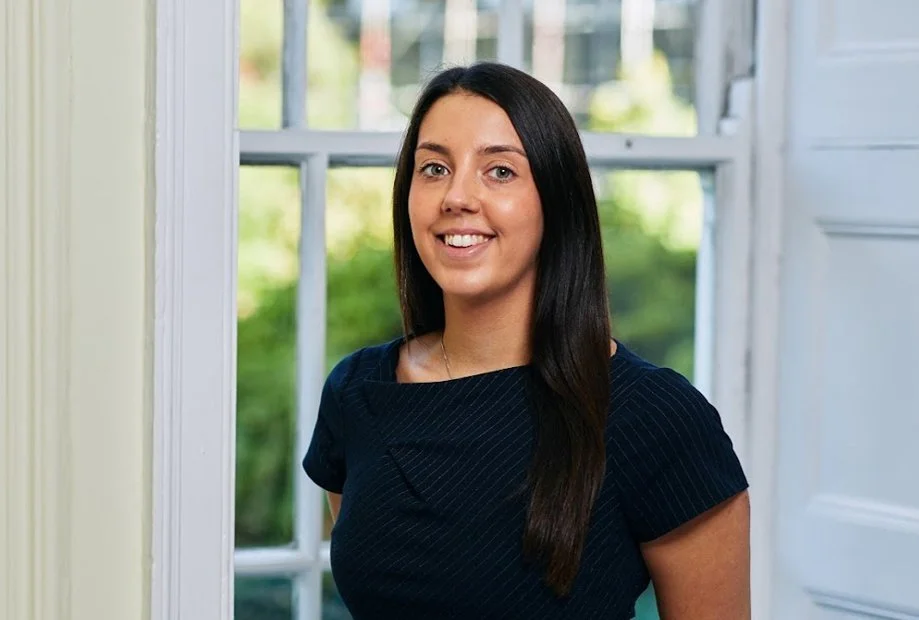
EP. 17
Emily Martin
Senior Clerk, 4-5 Gray's Inn Square
From Junior Clerk to Senior Clerk at 27: Emily Martin on Clerking, Chambers and Leadership
Emily Martin is Senior Clerk at 4-5 Gray's Inn Square — one of the youngest women ever to hold the role. She covers her route from the Temple at 18 to bringing Arden's members across to 4-5, building a parental leave policy from scratch, and what it takes to run a modern set.
Emily Martin started clerking at 5 King's Bench Walk at 18 — the Friday after finishing her A levels, having deferred a place at St Mary's University Twickenham to study PE teaching. She had intended to stay for a year. She is now Senior Clerk at 4-5 Gray's Inn Square, having spent eight years at Doughty Street Chambers, clerked the extradition team there, moved to Arden Chambers as Senior Practice Manager in 2017, and led Arden's members across to 4-5 Gray's Inn Square in 2018. She took over as Senior Clerk at 4-5 in January 2020. She completed a BA in English at Birkbeck, University of London whilst working full time at Doughty Street, and at the time of recording was about to begin a leadership master's at Bayes Business School.
In this episode, Emily traces the path from pushing the trolley at 5KBW to bringing Arden's members across to 4-5 Gray's Inn Square — and the skills that connected those two points. She describes what criminal clerking actually involves, the difference between prosecuting and defence work, how the move to 4-5 came together, and why she thinks smaller chambers will continue to struggle unless they find ways to diversify and grow. She also covers the parental leave policy she introduced at 4-5, which goes beyond what barristers are entitled to as self-employed practitioners, and what led her to build it.
If my gut tells me something doesn't quite feel right, it's probably the right instinct to go with. Try not to talk yourself out of it. Obviously there are always two sides to every story, but whatever it is — if that's your reaction, then probably listen to that.
Emily Martin, Senior Clerk, 4-5 Gray's Inn Square
Emily also addresses her experience as a female senior clerk in a male-dominated industry — her view is that the bigger challenge has been age rather than gender, and the short window she has when meeting potential new recruits to demonstrate that being young does not mean being less capable. She closes with advice for junior clerks: ask questions constantly, trust your instincts, invest in your own development, and treat your barristers like clients — because in most of the ways that matter, they are.
Share this episode
In this episode
- Emily's route into clerking — finishing A levels on a Friday and starting at 5 King's Bench Walk on the Monday, via a cousin who was senior clerk at Ely Place Chambers and a connection to Lee, the senior clerk at 5KBW.
- What the junior clerk role actually involves: pushing the trolley, making teas, picking up the phone, and daily runs to the Bailey and Southwark Crown Court — and why watching the clerks around her made her want to stay.
- Eight years at Doughty Street Chambers — moving up through the clerk's room, clerking the criminal desk, the defence-only culture and how that differed from the prosecution-led work at 5KBW, and the final three years running the extradition team.
- The difference between criminal clerking and other areas — reactive, fast-moving, built on relationships with listing clerks and court staff, and largely the same whether you are prosecuting or defending.
- Moving to Arden Chambers as Senior Practice Manager in 2017, identifying that the chambers needed something drastic, and finding the solution at a summer party where a conversation with 4-5 Gray's Inn Square led to a merger.
- Why smaller chambers are under increasing pressure: rising rents and fit-out costs, the regulatory burden requiring dedicated staff, and a natural ceiling on revenue in certain practice areas.
- The case for diversification — why having barristers across public law, planning, social housing, property and commercial makes chambers more resilient and more able to handle multifaceted instructions.
- Building relationships in a post-pandemic world: why getting members into chambers is harder than it was before COVID, what 4-5 has done to encourage it, and why Emily works better face-to-face than on Teams.
- Being female in a male-dominated industry — Emily's view that age has been the more visible challenge, and the short window she has with potential new recruits to demonstrate that young does not mean less capable.
- The parental leave policy at 4-5 — what it covers, why Emily introduced it for both self-employed members and employed staff, what a flexible rent break during maternity and paternity leave looks like in practice, and the baby loss policy that followed.
- Advice for aspiring junior clerks: always ask why, trust your instincts, invest in continuous learning, and treat your barristers as clients — because in most ways that matter, they are.
From this episode
Emily is characteristically modest about the Arden move. She went into a struggling set, identified the problem, held onto the members worth keeping, and found a practical solution at a summer party. The Arden members joined 4-5 Gray's Inn Square, and the combined set has grown steadily since. What she describes as grabbing an opportunity that doesn't come up very often was, in practice, the product of nine years of learning every room she walked into — the clerk's room at 5KBW, the criminal desk at Doughty Street, the extradition team, the social housing practice at Arden. None of it was planned as a route to running a chambers. It just turned out that all of it was useful when the moment arrived.
The parental leave policy is the same argument in a different form. Barristers are self-employed, and technically chambers has no obligation. Emily's position is that the technicality is beside the point. If someone is worried about where their work is going while they are on maternity leave, they will not take the leave they need, or they will not stay. The policy is not charity — it is retention. Her framing of barristers as clients is the clearest expression of how she thinks about chambers management: if you would not treat a solicitor that way, you should not treat your own members that way either.
Chambers have obligations around bullying, harassment, and equality and diversity that require training and documented processes.
Briefed produces two courses relevant to the themes in this episode. Anti-Bullying and Harassment Training for the Bar covers the obligations placed on chambers and what a compliant culture looks like in practice — relevant for any chambers building or reviewing its internal policies. Equality and Diversity Training for the Bar covers the BSB requirements and what chambers need to have in place, including the context Emily discusses around EDI committees and positive policy development.
About the guest
Emily Martin
Senior Clerk, 4-5 Gray's Inn Square
Emily Martin is Senior Clerk at 4-5 Gray's Inn Square, a leading public and commercial law chambers. She began her clerking career at 5 King's Bench Walk at 18, spent eight years at Doughty Street Chambers where she ran the extradition team, moved to Arden Chambers as Senior Practice Manager in 2017, and led Arden's members across to 4-5 Gray's Inn Square in 2018. She took over as Senior Clerk at 4-5 in January 2020, one of the youngest women to hold the role in the profession. She holds a BA in English from Birkbeck, University of London, completed whilst working full time. Chambers and Partners describes her as "an excellent and astute clerk" and she is credited by clients as "professional, accommodating, and commercially astute — often going above and beyond."
Transcript
Orlagh Kelly: So, Emily Martin — thank you for joining us. Senior Clerk at 4-5 Gray's Inn Square, and — I believe this to be true — one of the youngest ever female senior clerks in the industry. Welcome to the Get Briefed podcast. How are you?
Emily Martin: Thank you. Yeah, very well. Thanks, Orlagh. I'm really looking forward to speaking with you today.
Orlagh Kelly: You're very welcome. So I already know because I know you personally that you are very modest and unlikely to shout about your own achievements. I'm going to try to do that for you today or at least pull it out of you a little bit. But we're delighted to have you here. We honestly want to hear and understand from you what your career trajectory has been, how you've gotten to such a wonderful position in such a wonderful set of chambers at a young age — do you mind saying what age you were when you were appointed senior clerk?
Emily Martin: I was 27. Well — 26? No, I was 27.
Orlagh Kelly: 27. So yes, very young. And so can you tell us a little bit — how did you get started in clerking?
Emily Martin: Yeah, so I started at 5 King's Bench Walk in the Temple. Started there sort of by accident really. My cousin was the senior clerk at Ely Place Chambers and he is very good friends with — and colleagues with — the senior clerk there, who is still there, Lee. I sort of finished my A levels on the Friday and then started work with Lee on the Monday, having popped in a couple of weeks before on my cousin's introduction to say hello. They were looking for a junior clerk and I had two options. I got offered two jobs actually that same week — and I was meant to be going to university as well, but I'd deferred for a year anyway.
I thought, well, I'm just going to be knocking about for a year, so I'll earn some money. Lee invited me to go and work there, and that's what I started doing. I started there pushing the trolley.
Orlagh Kelly: Was the other job in the world of the bar as well, or was it totally different?
Emily Martin: It wasn't, yeah, it was totally different. It was to be an estate agent. Yeah, very, very different. So that was by chance as well.
Orlagh Kelly: And what about your degree that you intended to do? What was that in?
Emily Martin: That was in PE — secondary school PE teaching, actually, at St Mary's University, Twickenham. So very sporty generally as well. Lots of netball, hockey, rounders. I did a lot of long-distance running for Essex County. And I also did competitive Irish dancing.
Orlagh Kelly: Got that in common.
Emily Martin: I started Irish dancing when I was four and carried on for a long time, and then ended up doing some teaching at the dancing school that I was at. Quite enjoyed that. I guess that's kind of what led me to PE.
Orlagh Kelly: You've done teaching really from a teenager onwards, in that dancing world, and had really intended to move on to do that. Obviously then you hadn't really intended to enter the world of the bar and remain there as you have. So you were going in thinking, well, I'm just going to earn a bit of money for a year, get a bit of experience.
Emily Martin: Yeah, a year of work experience. But at the same time, I had a good clerk's room around me. Yes, I was the junior clerk — pushing trolleys around, making teas, doing all sorts, picking up the phone. I saw how much work they put in and actually how much they taught me as well. I kind of enjoyed being on the receiving end of that, but also thinking that actually this is a career where I can be in one of those more senior positions and be teaching others more junior to me, which obviously appealed to me quite a lot.
Orlagh Kelly: And so talk to me about your first year and when you came to that decision to stay on. What made you do that?
Emily Martin: I think I made it pretty quickly, to be honest. I just really enjoyed it. I really enjoyed the variety of different people that you come across in this job — different clients as well. They'd come in and out for conferences in chambers. I was up and down, going backwards and forwards to the Bailey and Southwark Crown Court pretty much every day. And the barristers — and the other clerks as well. In the Temple it's quite a small world. It was really interesting to me and I got to meet lots of interesting people. I made that decision quite quickly to stick it out and see where it led.
Orlagh Kelly: And so you give up your place at uni then — just decided not for you.
Emily Martin: Yeah. I don't think it was something I was sort of, you know — I think when you finish school, even at A level when you're 18, you don't necessarily know exactly what path you want to be on. I'm just speaking for myself, but you don't necessarily know. So yeah, I was enjoying working. I was enjoying being up in London.
Orlagh Kelly: Good social life, probably.
Emily Martin: Yeah, there were a couple of regular haunts that we'd go to. All the names of them have changed, obviously, since — but they're all still there. Yeah, so we had a good time. I was at 5KBW for 18 months, maybe just over that, and then sort of moved on from there, which is quite typical in a junior clerk role anyway — not to stay doing that for too long and to try and move forward and progress.
Orlagh Kelly: And where did you go next?
Emily Martin: I ended up making an application to Doughty Street Chambers and was fortunate enough to get a position there. I can't remember my exact title to be honest — it changed quite a lot when I got there. I was 4th junior clerk or something. They had a restructure and then called it different names. But yeah, I went there and was there for eight years in the end. Quite a stint.
Orlagh Kelly: What did you find, throughout those eight years — if you think about when you first started as a junior at 5KBW and when you left Doughty Street, you had kind of nine or ten years in the industry at that stage. What was the learning for you? Where were you growing your skills?
Emily Martin: I learnt loads. We had a really good team there. I was sort of one up from the junior clerk, and just ended up sort of by osmosis — you take in so much from the clerks around you. I learnt a lot, just social interactions as well. They did lots of events outside of chambers and inside chambers in the conference room there. So I got to meet lots of different people from different backgrounds. They had a very broad variety of clients and they only defend, so that was very different for me because I came in on the criminal desk. The criminal clerking just sort of ramped up really. And as I say, it was defence work only.
Orlagh Kelly: Whereas at 5KBW you were working with the CPS as well.
Emily Martin: Yeah. Given that you were on the criminal desk at 5KBW but that was very prosecution-led — working with the CPS, essentially briefed by the government — moving to Doughty Street, being on the opposite side where you were always working with the defendant. Was there a difference in how that all operated? One would imagine that working with the government would be very well planned, very smooth.
Orlagh Kelly: There was a lot of resource there and you're not, as a prosecutor, typically dealing with a member of the public potentially — or groups of people — as you are at Doughty Street. Is there anything in that? Can you see any differences in how you had to operate?
Emily Martin: Not really, to be honest. Criminal clerking generally is quite a reactive way of working. It doesn't really matter if you're prosecuting or defending, whether it's a legal aid client, a private client, or prosecuting for the CPS or whoever it might be. It's all very fast moving, things needed to be done yesterday — listing requests, building up a really good rapport with court staff and listing staff is key when you're a criminal clerk. So yeah, a lot of it is just very reactive clerking. There are obviously other longer-term goals, but it was all good fun, really.
Orlagh Kelly: So you had to think on your feet a lot. That's one I'm trying to identify as we go through — what skills a clerk really needs to have in any particular area. It sounds like thinking on your feet and being able to react positively.
Emily Martin: Yeah, and just be resilient, take everything as it comes, don't panic. What they don't want on the other end of the phone is a clerk that sounds unsure of what they need to do next — they need the reassurance there at the other end of the phone, even if the clerk is kind of panicking on the inside.
Orlagh Kelly: And so, in and around eight years at Doughty Street — what was next for you?
Emily Martin: Progression, really. I was there and I had obviously moved up within Doughty, and I wanted a new challenge. I was really enjoying my time at Doughty Street. My work was criminal and then it evolved quite a bit — the final sort of three years were very much clerking the extradition team there. I was very heavily involved in the work that they did and building up that team and recruiting. And that had a crossover that ended up touching on a little bit of arbitration there as well, which was good fun. Yeah, it was just sort of my time to progress and try something new.
And this opportunity came up at Arden Chambers. It was very different — a very different sort of beast really, because it was very much social housing and property law. Nothing like I had clerked before. But I was fairly confident that if you're a good clerk, you can clerk any area of law — obviously you read into what you're clerking and know a bit about the subject and speak to various people before you go. But yeah, I was looking forward to it. I went for a position there and was appointed Senior Practice Manager — a senior clerk role — at Arden Chambers in September 2017.
Orlagh Kelly: Fantastic. And how did that role go for you then?
Emily Martin: Yeah, it was a bit of a turbulent time in chambers. As I say, this was six years ago now, so we've moved forward quite significantly since then. But like many smaller sets of chambers, they were having their own struggles. When I got there it was apparent to me that something drastic may need to happen. But there were some really fantastic lawyers — I've still got them with me — and yeah, it was just that we kind of went to a summer party that year — or the year after, actually, I think — yeah, sort of the summer of 2018. And we ended up speaking to 4-5 Gray's Inn Square. We found out that they'd had similar struggles as well — some members had left, et cetera. So we decided to have a merger and see how things went, especially as our areas of law definitely complemented one another. We have public law in common anyway, but the social housing, property and planning side of 4-5 really complemented us. So we thought, let's give it a go. And yeah, the rest is history. It's been really good.
Orlagh Kelly: Really good success, I think. And what you're not saying there, essentially, is that you went into a set of chambers and identified some really brilliant assets within the business — apologies to the barristers for calling them that — but the business structure wasn't able to support it in the way that it needed to, and you essentially identified an opportunity at a summer party, created a pathway towards a merger which the stakeholders in both chambers bought into, and executed that merger successfully. Because of course you are 4-5 Gray's Inn Square and you're bigger and better for that merger. I think kudos to you for that — and I'm sure you did it alongside some of your colleagues as well. But not every 26 or 27-year-old thinks in that way. I wonder what part of your personality makes you think like that — from that problem-solving angle.
Emily Martin: I think growing up — I've got a great family, four siblings including myself, two older brothers — just being fairly resilient anyway quite helps. My mum and my nan are quite strong women, and that's definitely been instilled in me at a young age. Just to grab things and get on with it, don't moan, move forward and make the best out of the situation. I'm not one to dwell on something that has gone wrong — especially if you can't turn back time — learn from mistakes and move on. Own it and keep moving forward. Also, with the merger, it was definitely a collective effort. There were some members — Vicky Thompson, she's now at a set of solicitors, but she was the chief exec and was instrumental in getting everyone around the table. It was one of those opportunities that doesn't come up very often. And I think a lot of smaller chambers unfortunately are no longer open because they weren't able to grab those opportunities when they presented themselves and adapt and grow.
Orlagh Kelly: Just on that point then — adapting and growing — do you think that chambers will ultimately, over time, have to merge or come together in that kind of way to be able to survive at the bar? Is that how the profession is moving in your opinion?
Emily Martin: I think so. Smaller chambers will just inevitably find it harder to keep things going, depending on the sort of work you do. I came into a set which mainly did really good social housing cases, but there's a bit of a glass ceiling as to how much money that can be earned or revenue generated for the business — it's not international arbitration or a big commercial claim.
Orlagh Kelly: There's a top end of how much revenue can be generated.
Emily Martin: Exactly. And fit-out prices are going up, rents are going up — just generally the running costs of a business are a lot more. And there has been an increase in regulation at the bar, which we're seeing — a lot of sets having to appoint people full time to manage the regulatory requirements imposed. That's a salary that has to be found from somewhere, and if you're a very small business that would be very difficult to manage.
Orlagh Kelly: Although I know a lot of people in the profession feel that the smaller, more specialised sets bring a lot of value in their own right and shouldn't really be gobbled up. So hopefully there'll be a way in the future that everyone can continue to exist at the size they want to exist at. But certainly, for example, Gordon Walters, Director of Operations at Deka Chambers — they've gone through a merger of two sets that were quite big in themselves. How many members do you have at 4-5 at the moment?
Emily Martin: I think we're 88 at the moment. That's including our international members as well. And potentially room for a little bit more growth there over the next six months to a year or so.
Orlagh Kelly: So you're recruiting new members if they happen to come along.
Emily Martin: Some good lateral hires, I think, are what's needed. Having an overview of chambers, you find there are certain gaps in your armour — you might be turning work away. I hate turning work away, but if it's not something we can do I'd rather suggest somebody else and keep my reputation with that client than try and do something that's not within our remit. But yeah, just on that point of chambers merging and different areas of law — I think it actually makes you a stronger set. A lot of our instructions now are not just one thing, they're multifaceted briefs with public law, planning, public law angles. It can have social housing or discrimination claims and local government angles as well. Having not just a one-dimensional look at things, and barristers that can do a variety of different areas and different angles, is really valuable.
Orlagh Kelly: If you think about it, essentially what you've indicated is that you need to diversify to manage risk within the business. A set of chambers that's very specialised — if there's a strike, for example, in that entire world, that's massive risk to the business until it's resolved. Or if there's an economic downturn or a property crash, anyone involved in that will feel it. So the idea of having a bigger chambers with different segments keeps everyone afloat at any given time. And I'm guessing one of the benefits of being part of a smaller set is the ability to form relationships more easily with your colleagues. That's probably a bit tougher in the larger sets where there's an awful lot of people.
Emily Martin: It is. I think also — the larger the set gets — what I've tried to instil in chambers, and it comes with the personalities and the chambers culture that you have, is that not one area is held to a higher regard than another. You're in this together. Chambers benefits from all of its areas of law, it attracts all sorts of clients, and that's what makes it the chambers that it is. I think there could be those internal struggles at other sets the bigger they get, but I do feel that we have a really good chambers culture. I can't speak for other sets.
Orlagh Kelly: And so this has all been — it looks like you went in at 18, you progressed easily, you made friends, you created a merger, you're top of your game by pretty much age 27. There must have been some challenges along the way. Were there any that you can think of — that was a bad day, that was a difficult situation that I had to learn from ultimately?
Emily Martin: I mean, yeah — the merger was pretty tough, I must admit. That was quite difficult. The not knowing, et cetera. And there were obviously some losses along the way, and that's always quite gutting when people decide to place their bets elsewhere because it's just the unknown. Losing members is always something I don't enjoy. And I would say — building trust with members and with staff is really a difficult thing to achieve, especially when there have been previous experiences out of your control, before you've got to know them. It's not an overnight thing. That relationship has to be a two-way street. And that's super hard, but it's really worthwhile — you get a bit of a kick out of it when you know that actually we're all on the same page, moving in the same direction, and there's no question that the trust is there. Yeah, it's great.
It makes for a really good work environment as well.
Orlagh Kelly: And so, from listening to you, it's clear that one of your key skills must be building relationships — because you've been aware from the age of 18 that that's been fairly key to doing a good job. Whether those relationships are internal with your own clerking team, with your barristers, the listing clerks at court. From having spoken to a lot of other people on the podcast, that's a key theme — building relationships is really the essence of being a successful clerk, a successful barrister. However, it's not as easy as it used to be to build relationships in this post-pandemic digital world. It's harder. It would appear in almost every set of chambers to get barristers to come in frequently into chambers — where, in my opinion, building relationships is typically about meeting people in person, face to face. Do you have any difficulty in terms of creating that in-person culture?
Emily Martin: Yeah, it's definitely much harder. I don't think we're the only chambers facing that difficulty — getting members to come in, etc. The encouragement's there. We want to see as many faces in chambers as possible. And it hasn't gone back to pre-COVID levels. I'm not sure that it will.
I think if you've got used to working from home, it's more of an upheaval to then try to change your work pattern again when you've got a good setup at home. We've done various bits and pieces to try and get members to come in — a chambers lunch and breakfast, and it always surrounds food, feeding everyone. Different social drinks or whatever. To be honest, we had our summer party last Thursday and the turnout from members of chambers was just outstanding. It was so nice to sort of see everybody in one place. Makes it quite extra special, I guess. You obviously get your members — stock members — that will always come in, and I'm really grateful for those who do come in. It's just good to see them, good to talk to them, and it helps me out. I definitely work better on a face-to-face, in-person basis. It was quite a difficult adjustment to have various Microsoft Teams calls when you just want to have eye contact, shake someone's hand — when it's remote there's always a bit more of a time pressure on it somehow. You want to get down to business as opposed to having a bit of craic. So, yeah.
Orlagh Kelly: And then I mean, I guess I have to ask the question — I hate this question but I have to ask it — have you noticed any challenges that have come particularly from being female in a relatively male-dominated industry?
Emily Martin: It's a tricky question. Not necessarily — not that I know of. I think that most of my peers, and even those who are more senior in years to me but maybe more junior to me in the structure of chambers, have been really supportive. I know that sounds too good to be true, maybe, but no.
I think it was more difficult when I was much more junior in the clerking, in the clerk's room, as a female. I think that when you're more junior you can kind of get pushed around more. Maybe it's got nothing to do with my sex at all. But you can, yeah — it can be quite tough. You've got to be quite resilient to deal with, as I say, different people, all different temperaments, all different backgrounds. You just have to suck it up and move on to the next thing, not let it get to you.
I have had a couple of encounters with some clients not too long ago where Stephen and I were in a meeting with them, I was asking lots of questions and I was sort of running the meeting. But I wasn't being spoken to — no eye contact with me. They would just respond and look to Stephen. And that was throughout the whole meeting. Stephen's my deputy senior clerk, a really nice guy, more senior than me in terms of his years clerking. We've got a great relationship. We come out and he was actually quite gobsmacked — and quite gutted. I just sort of said, look, it does happen sometimes. It doesn't matter — if I was asking the questions, they'd look straight to Stephen and answer the question. It was like they didn't want to engage with me. You sometimes have to suck it up and get on with it.
I also think — and this may be unseen, I don't know, I haven't any evidence of it, there's no chip on my shoulder about it — but especially when I'm speaking to potential new recruits, members who may want to join, I always have in my head — because they do comment, you know, you're very young for a senior clerk, etc. I wonder what they're thinking, what they don't elaborate on. Sometimes I think, well, do you see that as a negative? And I have a short period of time to convince them that that doesn't matter, and that what actually matters is all these other things. So yeah, it's something I don't have any real physical evidence of, but it's always there. I think maybe it's in my mind more than in theirs.
Orlagh Kelly: Yeah, it might be. What you might be suffering from is the fact that you're such a high flyer at a young age. And it's actually that you look young — it might not be gender at all. If Stephen looks a little bit older than you, it might be age as opposed to gender that's kicking in.
Emily Martin: Yeah, it might be. It's really hard to know. And in the same instances, I've come out of meetings thinking, I'm not sure they're completely sold on me, chambers, et cetera. And then they say, can't wait to join and send in an application. So maybe it's a bit of imposter syndrome kicking in for me.
Orlagh Kelly: Yeah, absolutely. And so, thinking about where you are now — you're still really quite early in your career, but you're senior clerk, which is ultimately top of the tree. Where do you go from here? Do you envisage that's you now, that you'll spend the next 30 years as senior clerk? That does happen within the industry — it's actually quite usual. Or do you see different things in your future?
Emily Martin: I love being senior clerk. I love chambers — the chambers that I'm at now. I think there's actually a lot for me to still do there. I don't think it stops with just being senior clerk. There's so much more to do within the business. We're good at so many things, which is testament to everybody. But I want to hone in on the strengths that we have across chambers and really focus on those, build them up and enhance them over time. There's a lot of work to do. It's client-facing, branding, marketing — lots of ways to grow.
Orlagh Kelly: And so thinking about that — I know that you've spent and invested quite a bit of time and effort in the equality, diversity, and wellbeing of your members. Some of the initiatives you've introduced: around parental leave, you've introduced a policy — and I think you've had something of a baby boom at 4-5.
Emily Martin: Our second baby boom, I think. Maybe a third wave, we shall see.
Orlagh Kelly: Well, if there's nothing more to say.
Emily Martin: There's nothing stopping them — they're formidable people, so I'm sure they'll be fine.
Orlagh Kelly: So that's wonderful. If you could show a sign of success, it's the fact that people are able to have baby booms within chambers. And I know that alongside that you recently rolled out a baby loss policy, and you've been doing lots of other things — you've got a very vibrant equality and diversity committee working on anti-bullying and harassment, making sure that your members and your own staff team are well protected and supported in every environment, which is wonderful to see.
Emily Martin: Yeah. The next thing I think is we need to look at the safeguarding side of chambers as well. There's lots going on there. But yeah, the parental leave policy — we're really proud of it. It's on our website. It goes above and beyond what's required.
Orlagh Kelly: What was the kickoff for you in relation to that? Because for those listening who maybe aren't from the bar — barristers are actually self-employed, in which case there's no obligation on chambers to do anything really. So what was the impetus for you to go past that technicality and do something better for your members?
Emily Martin: I think we wanted the members — we wanted it to be spelled out. The last thing you want is to be finding out you're going to have a baby and panicking about where all your work is going to go, because as you just said, barristers are self-employed. Any self-employed person, whether or not they've got family or caring commitments, will worry about where their next piece of work is coming from. The last thing you want to be doing is trying to work out what parental leave rights you have or don't have and going looking for it. So we wanted it to be really clear, really visible, and just obvious to any member — whether they're thinking about it, or who's fallen pregnant, or mums and dads, it applies to everybody — that chambers would be there and support them. Yes, they're self-employed, but you're part of a collective.
And that parental leave policy isn't just for members. What I like about chambers — because you have the employed people in the staff and the self-employed members — what we're looking at is incorporating everyone within those new policies so that no one's excluded. So whether that was giving a really attractive and flexible rent break for people going on maternity, paternity or parental leave — it's all on their terms, because we have that relationship where we can communicate back and forth with the members and with each other. It's not a struggle, it's just there and clear, and it makes everybody's life a lot easier. It's kind of under review. We've got people on maternity leave at the moment who have said, oh, I could do maybe a little bit of this or that — would you mind just sending me some opportunities that come in? And it's like, yeah, absolutely. It's all on their terms. It's good.
Orlagh Kelly: It's a big change. Well done. You're really leading the path there — ahead of the curve, as they say. And so if I was to say to you, reflecting on your career today — what advice would you have for someone new coming in as a junior clerk?
Emily Martin: I think always ask questions. Probably quite annoying generally, for as long as I've been doing this. I'm always asking why, even now, just to understand the inner workings of everything. Maybe it's just a curious personality. But if you know how things work, and just know individuals — how they work, what drives them — it's easier to grow as a person yourself, but also with the business. Trust your instincts as well. That's probably a really important one, this has been for me anyway. If my gut tells me something doesn't quite feel right, it's probably the right instinct to go with. Try not to talk yourself out of it. Obviously there are always two sides to every story, but whatever it is — if that's your reaction, then probably listen to that.
I'm always trying to — as I say — ask why, and learn more all the time. I'm going to be doing another master's, effectively, starting at the end of this year. I went to university when I was at Doughty Street — I did my English degree whilst I was working, in the evenings over four years, full time. And I'm just about to start my master's in September or October time. It's a leadership course. It's with Bayes Business School.
So yeah, I'm just about to do that. I think that really helps as well, because you broaden your outlook — not just within the bar, not just within chambers or solicitors firms. There's actually a lot more opportunity and scope out there that chambers can get involved in, not just the traditional routes. Your network grows through that, you grow as a person, and you can benefit the business if you're at your best and learning more.
Orlagh Kelly: So ask questions, make sure you continue to develop your own personal and professional learning and listen to clients. I guess listening to your barristers as well.
Emily Martin: Your barristers are effectively clients as well, to an extent — they probably won't like me saying that, but they are really. And you can't do anything without the team around you. I try and get my staff to advocate for themselves — to say, I'm not very good at X, or if there's a gap in their knowledge or they want to learn something new. Whether it's a business development angle, training in relation to public access, or anything really — I encourage them to come to me and ask for it. I want them to know that chambers and I are behind them. If they want to do something like that, it's not going to be shut down. If you've got everyone working to a high standard and their knowledge is there, then the client's going to be happy.
Orlagh Kelly: It's easy to see why you're continuing to grow and why you're continuing to retain both your own team and your barristers with that very much leadership outlook of looking after everyone and supporting everyone in their own personal and professional careers. So well done. I'm not sure the master's is going to teach you very much that you don't know already, but fair play to you for wanting to.
Emily Martin: I'll learn a lot. Yeah, time will tell. But I'm sure I'll learn a lot from it.
Orlagh Kelly: Thank you so much for speaking with us. It's been lovely as usual. And I'm sure I'll get you back on in the not too distant future to tell us about what else you've been doing, growing and changing. So thank you for your time, and I will talk to you soon.
Emily Martin: Thanks, Orlagh. Thank you.
Listen and subscribe
New episodes published monthly.
You're subscribed. New episodes monthly.
No spam. Unsubscribe any time.